The troublesome weed Waterhemp has recently shown resistance to Group 15 herbicides in Illinois research plots. Experts recommend changing weed control techniques now.


Urea, anhydrous ammonia and liquid urea ammonium nitrate (UAN 28 or 32%) are by far the most common sources of nitrogen fertilizer used in corn production. Moreover, all 3 sources of nitrogen fertilizer have their own unique advantages and disadvantages, but in particular, dry urea is an exceptionally poor source of nitrogen for in-season applications to corn. At first glance, urea seems to be an attractive in-season nitrogen source, because it can be applied rapidly with high clearance dry spinner spreaders and urea is commonly a few cents per lb of nitrogen cheaper than UAN. Urea, however, is highly susceptible to N loss via ammonia volatilization and uniform fertilizer nitrogen distribution can be a serious problem for top yields and maximizing economic returns.
Ammonia volatilization occurs when the urease enzyme hydrolyzes urea fertilizer to ammonia on the soil surface. Given ammonia (NH3) is a gas and lighter than air, the ammonia literally floats away into the atmosphere. The most effective way to prevent ammonia volatilization is for urea hydrolysis to occur beneath the soil surface where the ammonia gas can interact with hydrogen ions to form ammonium (NH4+).
To avoid serious N loss, urea must be incorporated with tillage, moved below the soil surface by precipitation or subsurface injected. For in-season N application, however, physical incorporation or injection of dry urea is not practical, leaving a rainfall event that must exceed 0.5 inches to move the urea below the soil surface (figure 1). This significant rainfall event must occur no later than 4 days after urea application (figure 2) or N loss from ammonia volatilization could drastically accelerate in subsequent days (Jones et al., 2013). UAN is also susceptible to ammonia volatilization, but only 50% of the nitrogen in UAN is urea. Therefore, UAN is roughly half as susceptible to ammonia volatilization as dry urea.


UAN also provides more flexibility regarding in-season applications than dry urea. UAN can be subsurface injected or surface banded within the row. Subsurface injection of UAN strongly reduces the potential for ammonia volatilization because urea hydrolyses occurs below the soil surface. Banding UAN on the soil surface does not eliminate ammonia volatilization, but reduces the risk of ammonia volatilization considerably (figure 2, Jones et al., 2013). The reduction in ammonia volatilization risk with banding UAN occurs because banding physically reduces the amount of N fertilizer exposed to the urease enzyme.

Achieving uniform application with dry fertilizer, which includes urea, can be a difficult task. Several problems exist that can lead to non-uniform urea applications. If urea is not uniformly sized, the result is segregation of larger and smaller urea particles during loading, transportation to the field and during spreading. Particle segregation is a problem because larger urea granules are thrown further from the dry spinner spreader machine than smaller particles, resulting in a higher application rate directly behind the machine and a lower applications rate at the edges of each pass.
Segregation is not the only concern. When side-dressing corn, poor urea distribution can be exacerbated by the standing corn crop, particularly when corn reaches over a few feet in height. Tall corn acts as a funnel, cutting down the distance at which the urea granules can be thrown compared to when no crop was present to disrupt the flow of urea toward the edges of each pass.
The on-farm studies were conducted at 3 locations in the 2016 growing season. The locations included Elkhorn, WI, Tipton and Morning Sun, IA. The base and side-dress N rates used at each location are listed in table 1. At each location the side-dress nitrogen was applied at growth stages between V6 to V8 as either surface banded UAN or surface broadcasted urea. At each location these treatments were replicated 3 or 4 times. The price of UAN and urea used to calculate partial profit was 0.36 and 0.32 $/lb N. The price of corn used to calculate partial profit was 3.50/bu.

Averaged over the 3 locations yields were increased 5.5 bu/ac from surface banded UAN when compared to surface broadcast urea (table 2 and figure 3). In addition to higher yields from surface banding UAN vs broadcasting urea, net profits were 16.2 $/ac higher for the surface banded UAN treatments, despite slightly higher nitrogen costs (table 3).


Because urea cannot be physically incorporating post-planting, it is susceptible to loss via ammonia volatilization (loss to the atmosphere as NH3 gas). Moreover, uniform application with dry fertilizer, including urea, can be problematic due to segregation of larger and smaller urea prills and due to physical spread pattern interference from standing corn. For these reasons, urea is a particularly poor source of nitrogen fertilizer for in-season applications. In these 3 on-farm trials surface banding UAN increased yields 5.5 bu/ac and net profits 16.2 $/ac compared to surface broadcasting dry urea.
Jones, C., B.D. Brown, R. Horneck, D. Olson-Rutz. 2013. Management to Minimize Nitrogen Fertilizer Volatilization. Extension Publication EB0209. Montana State University. http://www.landresources.montana.edu /soilfertility/documents/PDF/pub/UvolBMPEB0209.pdf.
– Dr. Jacob Vossenkemper (Agronomy Research Lead)


In 2018, EPA extended the registration for two years for over-the-top use (i.e. use on growing plants) of Dicamba to control weeds in fields for cotton and soybean plants genetically engineered to resist Dicamba. This decision was informed by extensive collaboration between EPA, the pesticide manufacturers, farmers, state regulators, and other stakeholders. The registration includes label updates that add protective measures to further minimize the potential for off-site damage. The registration will automatically expire on December 20, 2020, unless EPA further extends the registration. States affected include Iowa, Illinois, Minnesota, and Wisconsin.


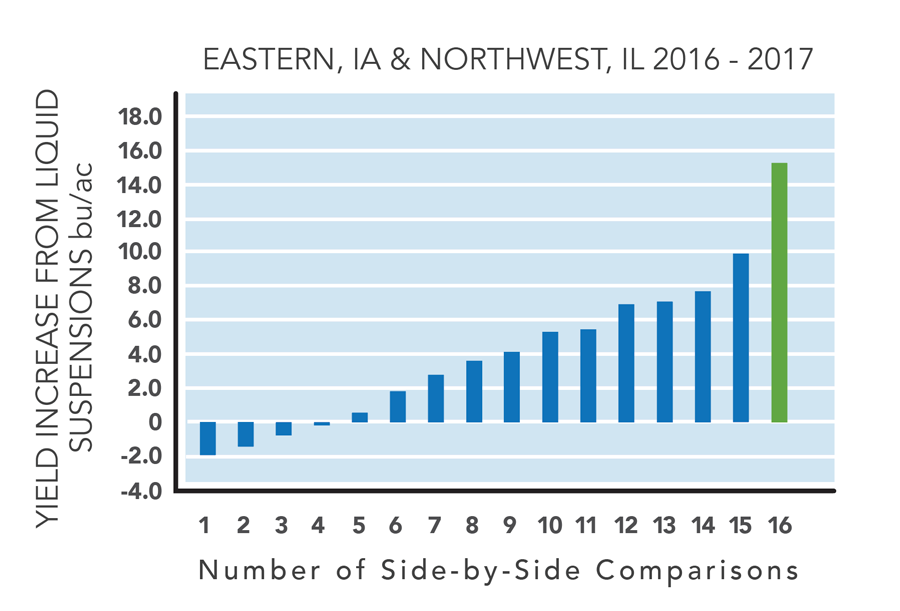
Besides being cost-effective, liquid suspensions are extremely easy to surface or subsurface band.
Banding nutrients achieves two goals: reduced phosphorus fertilizer fixation with Ca2+, Al3+, and Fe3+, and roots become highly concentrated in nutrient-rich fertilizer bands (figure 1). As a result of reduced phosphorous fertilizer fixation (tied up in non-plant-available forms) and increased root activity in nutrient-rich fertilizer bands, the amount of applied fertilizer that is taken up by both corn and soybean crops is increased. In fact, a group of crop scientist recently organized 39 science-based studies with the objective of comparing the effects of banding vs broadcasting fertilizer phosphorus on nutrient uptake and crop yields (Nkebiwe et al. 2016). Averaged over 112 comparisons of banded vs broadcasted phosphorus fertilizer sources, they found that banding phosphorus fertilizer increased nutrient uptake by 12% (figure 2) and corn yields by 4.5% (9 bu/ac or $31/ac at 200 bu/ac yield level) compared to broadcasting the phosphorus fertilizer sources.



On Monday, October 1, 2018, Taiwanese trading partners agreed to up their soybean imports from the U.S. by 37 percent, compared to the previous year.
According to a statement from the Iowa Soybean Association, 2018 is expected to be a record yield.
https://wqad.com/2018/10/01/taiwan-agrees-to-buy-more-soybeans-from-the-u-s-iowa-farmers-rejoice/
There’s a new doctor in the field. And by “field” we mean the corn field.
For the last two and a half years, Liqui-Grow’s Lead Agronomist, Jake Vossenkemper, has been working on his dissertation in Crop Sciences at the University of Illinois. Jake has been a PhD student since the spring of 2012.
On Monday, March 27, 2017, Jake gave his final defense for his dissertation on crop management factors that interact with soybean planting dates. Through his research, he found that soybean-planting date, seed treatments, and cultivar maturity selection are all-important management decision to consider for producing maximum soybean yields. He also found that warm fall temperatures can increase soybean yields by 3 to 6 bu/ac compared to normal fall temperatures. In addition, he found that when temperatures remain warm in the fall, full-maturity soybean varieties often out yield mid-maturity soybean varieties. These finding add to our understanding of what factors are important to maximizing soybean yields, and may help soybean breeders breed for resistance to cold late-season air temperatures.
We are all very proud and excited for Jake’s most recent accomplishment! He will graduate on May 13, 2017.